I’ve wanted for some time to create a simple infographic of where a book’s cover price goes, and the Observer published a nice one in their Book of Books a few months ago. The figures made sense, so I’ve created a similar one here, in colour.
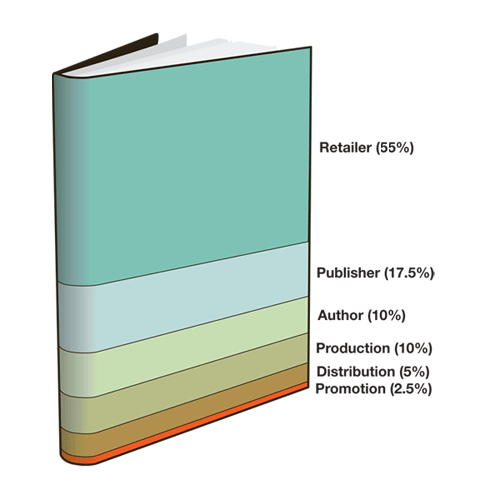
The Observer’s figures were based on a notional £20 hardback book, from which I’ve extracted the percentages, which in my experience hold fairly true across standard formats for traditionally produced books in the major bookshops. So for a £10 paperback, the retailers will take anything between a 40% to a 60% discount (and guess who’s trying for more), and the author can expect to see about a quid, depending on their terms.
I think this illustration serves a number of purposes, not least to illustrate the mark-up taken by the retailers. There’s some justification for this by bricks-and-mortar stores, with huge overheads, but I’m yet to hear a decent one for internet retailers, who don’t have shop rents to pay – their motivation, of course, is simply to undercut the high street. Publishers are giving away huge sums in their failure to compete on direct sales – and they’re going to struggle to justify high ebook prices too.
The total is 90%. Where are the 10% going?
Comment by Alain Pierrot — August 22, 2008 @ 9:20 am
Oops – 45% should have read 55%. Thanks for the heads-up Alain. Corrected.
Comment by James Bridle — August 22, 2008 @ 10:09 am
That’s an interesting chart. And for writers looking at self publishing on a low volume single consignment or POD basis, the production costs will double or tripple.
I wonder what the model for eBooks will be like when prices settle? One thing is for sure, retailers will still be taking their cut.
Comment by Adrian Graham — August 22, 2008 @ 11:08 am
The chart is helpful Thank you. What would really help would be the next level of detail. Start with the Retailers selling price and then break out the cost components for the retailer. A second chart which starts with the Publishers net price and then segments into the Publishers cost pools would provide greater insight into the e-book vs hard copy book price debate.
We should all remember that consumer market forces will decide this question and not Publisher of Retailer cost models. There will be a precieved value for the book in each platform that, when profitable scale is reached, will establish market price.
Comment by John Conley — August 29, 2008 @ 4:32 pm
For me, the numbers have been more like this:
65% production
55% retail
5% distribution
0% promotion
-25% publisher and author
Comment by A broke indy publisher — September 3, 2008 @ 6:01 pm
Are you saying that on a $30 book you pay the following;
Production —- $19.50
Retail ———– 16.50
Distribution —– 1.50
Author & Publ 7.50
Total ———- $45.00
Net Loss ($12.00)
If so how are you producing the book?
Comment by John — September 3, 2008 @ 6:28 pm
[…] 1.0: Where The Money Goes The divided book I’ve wanted for some time to create a simple infographic of where a book’s cover price goes, […]
Pingback by Books 1.0: Where The Money Goes « Mike Cane 2008 — September 7, 2008 @ 8:40 pm
[…] at BookTwo takes a look at the price of books and where that money goes: I think this illustration serves a number of […]
Pingback by What We Pay for When We Pay for Books — October 8, 2008 @ 6:48 pm
[…] No they’re not! I’ve seen charts. It’s mostly physical […]
Pingback by Sony Reader PRS-700: Part Three « Mike Cane 2008 — October 8, 2008 @ 11:34 pm
Nice graphic James – there would be a lot of rich book retailers around if we all made 55% mind – in reality much of that 55% goes on:
Retailer distribution
(if online) shipping costs
Staff
Heat/Light etc
Returns
and then… the customer takes quite a significant discount off the remaining margin!
Comment by Kieron — October 10, 2008 @ 4:53 pm
[…] the cost of production, distribution and retail overhead – is worth $20, a digital book is not. Cut the price accordingly. Take your margin, but don’t abuse your customers with outrageous prices for ebooks […]
Pingback by What Publishing Can Learn From Music — October 14, 2008 @ 2:41 pm
[…] the cost of production, distribution and retail overhead – is worth $20, a digital book is not. Cut the price accordingly. Take your margin, but don’t abuse your customers with outrageous prices for ebooks […]
Pingback by hughmcguire.net · What Publishing Can Learn Music — October 14, 2008 @ 2:47 pm
[…] cost of production, distribution and retail overhead — is worth $20, a digital book is not. Cut the price accordingly. Take your margin, but don’t abuse your customers with outrageous prices for e-books […]
Pingback by Hugh McGuire: What Publishing Can Learn From Music | PoliticsMuch.com — October 14, 2008 @ 10:08 pm
@Kieron – I think that blaming the customer for taking “quite a significant discount off the remaining margin” is a bit odd – the retailers are offering these discounts in a destructive price war, and pushing the cost back onto the publishers.
Comment by James Bridle — October 15, 2008 @ 12:01 pm
[…] The divided book | booktwo.org […]
Pingback by Edublog Suspended: Politics Around the Web 10/16/2008 | Beyond School — October 16, 2008 @ 1:33 am
Hi James
No blame from me on customers, sorry re-read my post and it does sound a little like that! As a retailer I’m just happy customers choose to buy books from me – and the reasons they do so are a mix of price, availability, promotion and sometimes personal recommendation (when I’m very lucky).
All I wanted to point out is that there aren’t ‘fat cat’ retailers running over the hill with 55% – if they were I’d have bought my house years ago.
Pricing and books is an interesting discussion – since the end of the Net Book Agreement the emphasis has been more and more on volume sales, mostly driven by the internet and discounting by Amazon. 50% off as a sales message has now become the standard message for frontlist – just look at the windows of any major bookseller on the high street.
This is, to a degree, the fault of book sellers themselves – in an attempt to retain market share in the face of the internet in over expanded square footage (Borders, and the out-of-town stores) and not looking to differentiate outside of price. However this can’t be said to be unusual in a commodity product market – and booksellers still do amazing promotions and support new authors and exciting books every day. Some of the recent Waterstone’s promotions have been great (the postcard stories, writer’s table etc).
What is a real challenge is to attempt to break out of a price driven offer – but I can’t see how this will happen easily. The web, pricing and availability has increased book sales overall, but to a declining set of customers.
Any suggestions?
Comment by Kieron — October 18, 2008 @ 7:06 pm
[…] think I’ve seen the most haunting graphic of my life here. Well, no author is into writing for the money I suppose. 10% though? There should be another way […]
Pingback by Where does the book cover price go? | The Renaissance Thinkers Blog — October 23, 2008 @ 12:56 pm
[…] on figures produced by The Observer, BookTwo has produced a wonderfully simple infographic depicting the percentages of the split (for a £20 hardback): Retailer: 55% Publisher: 17.5% Author: 10% Production: 10% Distribution: 5% […]
Pingback by Where a Book’s Cover Price Goes » Lone Gunman — November 3, 2008 @ 10:49 am
I see the percentage given for retailers as a bit generous. In my experience as a bookseller (about 15 years) the average bookseller discount off the retail price is 37%. Discounts start at about 15-20% for educational titles and 40% and above only offered by a small number of suppliers. The big ones like Random, Penguin etc usually sit at 35-37.5% even for quite big retailers. Although I know some have negotiated to 40-42%. I’ve only seen 50% discounts and higher on selected items the publisher wants to be rid of.
Comment by Warren — January 30, 2010 @ 6:00 am