Brief outline of ideas for locative storytelling (more thoughts originating from here and here).
Goal: To produce a locative storytelling experience, where strands of the story are triggered by the reader/listener’s location.
Tech requirements: GPS-enabled mobile phone, or Google Maps’ new locator function, headphones, application running on Symbian or Windows Mobile (or preferably both…).
Personnel: Writer or team of writers, developer, interface designer, voice actor.
Issues: Low GPS penetration – few handsets currently but set to change rapidly – GMaps not yet accurate enough, at least outside large towns.
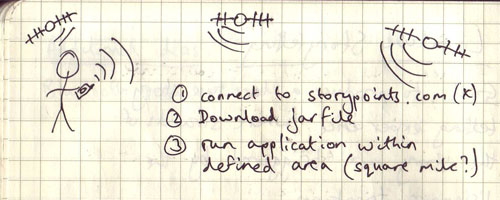
Proposal: Create a downloadable application which runs on a mobile device. Each standalone app contains a story, specially created for the medium and a particular location (although it would be possible to edit stories with strong localities for this, the former offers more possibilities).
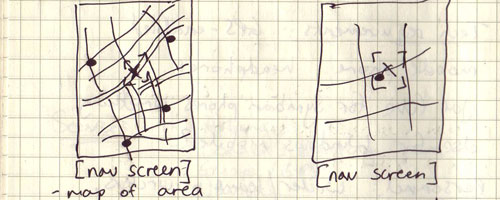
Running the app spawns a navigation map – either a GMaps overlay or a specially created one (perfectly possible for small areas), showing the user’s location (X, above, wide and zoomed) and the accessible storypoints – location-specific ‘shards’ of the story.
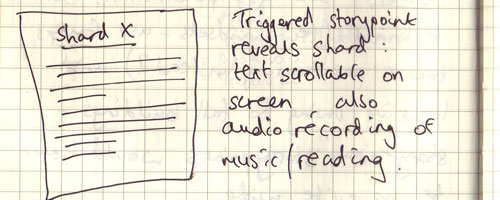
As the user moves across the map, they come into contact with the storypoints – close enough, and they trigger the shards associated with that point: scrollable texts, an audio recording, even images or video.
This format offers a number of interesting possibilities for the narrative form, beyond a simple (and still wholly possible) linear structure, such as:
- Multiple entry and exit points
- Threaded/associative storytelling (storypoints only revealed after certain others have been visited)
- … tending to “Choose your own adventure” style
- Surprise shards (hidden storypoints)
- Story as treasure hunt.
To achieve the full potential, it would require a writer prepared to engage with (at least partially) non-linear storytelling.
So, that’s a start. Thoughts? Would be pretty sweet to set one of these up in time for London Lit Plus in the summer…
Further reading:
This sounds like a fantastic. I am really interested in the way this kind of application broadens the scope of what we would traditionally think of as a story. In some senses our daily lives form narratives, yet when we think of narrative we think of something self contained. “Life” and “stories” can’t be so easily separated in this model and I think that sounds extremely exciting.
For me London is the perfect city for this- Peter Ackroyd called it London’s topographical imperative, that ability to cluster myths or trades or styles in set locations. Walking around London is at some level like being part of a four dimensional narrative which could then be given a further, more structured layer to engage with.
As a side point have you seen this project from Proboscis: http://urbantapestries.net/? It might be worth talking to them…
Comment by Michael Bhaskar — January 21, 2008 @ 2:33 pm
this was a very fascinating idea to read about and I quite liked your sketches. you might be interested to know about Murmur, it is a project with a similar inspiration, it uses little flyers posted around a city (at each geolocation), each with a unique phone number printed on it. calling this number will read out a voice message which plays apart in the story effectively.
http://murmurtoronto.ca/
Comment by jeevs sinclair — February 1, 2008 @ 4:14 am
@Michael – Proboscis are great, aren’t they? I had seen Urban Tapestries and I’ve been meaning to play with Snout for a while.
@jeevs – Murmur is very cool, thank you for that. Reminds me of http://yellowarrow.net/ too.
Comment by James Bridle — February 1, 2008 @ 11:46 am
Hey guys!
Your vision come true :) Have a look at our iBookmark prototype. A GPS enabled eBook reader:
http://ifgiweb.uni-muenster.de/~j_scho09/pubs/CHIWorkInProgressmultistory.pdf
Have fun while reading. We are currently looking for writers who are interested in writting stories for the iBookmark protoypes.
Cheers,
Johannes
Comment by Johannes Schöning — April 24, 2009 @ 9:43 am
[…] Storypoints: A locative storytelling proposal | booktwo.org Locative storytelling: using the reader/listener’s location to trigger an interactive story experience. (tags: storytelling interactive) […]
Pingback by links for 2010-01-15 « The Whippersnapper — January 16, 2010 @ 3:02 am